

Enforcement of Electronic Arbitration Awards in Saudi Arabia Legal Research on Electronic Arbitration Awards in Saudi Arabia The enforcement of electronic arbitration awards has become an important legal topic in Saudi Arabia, especially with the rapid growth of digital transactions, online dispute resolution, and electronic judicial services. This research paper examines how electronic arbitration awards in Saudi Arabia may be recognized, reviewed, and enforced before competent Saudi courts. Prepared by Prof. Dr. Turki bin Abdullah bin Aqeel Al-Tayyar, the study presents a comparative legal analysis based on Saudi regulations and Islamic jurisprudence. It focuses on the legal conditions, procedures, competent authority, and judicial applications related to electronic arbitration awards. Electronic Arbitration Awards Digital award enforcement under Saudi legal procedures. Saudi Arbitration Regulations Legal framework for enforcement before competent Saudi courts. Islamic Jurisprudence Sharia-based analysis of arbitration enforcement rules. Digital Justice Platforms Electronic records, e-signatures, and online enforcement tools. Research Highlights Electronic Arbitration Awards The research explains the legal nature of arbitration awards issued or managed through electronic means. This includes digital communication, electronic documents, online procedures, and electronic records used during arbitration. Saudi Arbitration Regulations The study reviews the Saudi legal framework related to arbitration enforcement. It explains how Saudi regulations may support the enforcement of electronic arbitration awards through legal rules, procedural requirements, and judicial interpretation. Islamic Jurisprudence Perspective The research connects the enforcement of electronic arbitration awards with Islamic jurisprudence. This gives the study a strong legal foundation aligned with the Saudi legal system and Sharia principles. Digital Justice and Enforcement The paper highlights the role of digital transformation in Saudi Arabia, including electronic litigation platforms, electronic filing, digital documentation, and enforcement procedures supported by modern judicial services. Key Legal Issues Covered in the Study Competent Authority for Enforcement The research discusses the competent authority responsible for enforcing electronic arbitration awards in Saudi Arabia. This is essential because the award must be submitted before the correct judicial body to proceed with enforcement. Conditions for Enforcement The study explains that enforcement depends on several legal conditions. These include the validity of the arbitration agreement, proper procedures, finality of the award, correct submission, and compliance with Saudi regulations and Sharia principles. Electronic Records and Digital Authentication Because electronic arbitration relies on digital documents, the research emphasizes the importance of electronic records, electronic signatures, and digital authentication. These elements are important for proving the validity and reliability of the arbitration award. National and Foreign Arbitration Awards The research addresses both national and foreign electronic arbitration awards. It also discusses the need for clear procedures when foreign arbitration awards are intended to be enforced in Saudi Arabia. Main Findings of the Research The research concludes that Saudi regulations may allow the enforcement of electronic arbitration awards when the necessary legal and procedural requirements are met. It also indicates that Saudi judicial practice is moving toward accepting electronic arbitration awards, especially with the growing use of electronic litigation and enforcement platforms in the Kingdom. The study further recommends strengthening regulatory provisions related to electronic arbitration awards, particularly in matters involving electronic documents, digital authentication, foreign awards, and potential forgery in electronic records. Why This Research Matters for Businesses and Investors Electronic arbitration is increasingly relevant for companies, investors, contractors, technology businesses, financial institutions, and cross-border commercial parties. For businesses, understanding the enforcement of electronic arbitration awards helps reduce legal risk when drafting contracts and arbitration clauses. For lawyers and arbitrators, the study provides useful guidance on how electronic procedures should be managed to remain valid, reliable, and enforceable before Saudi courts. Atyar’s Legal Expertise in Arbitration and Enforcement Atyar Advocates and Legal Consultants has strong experience in arbitration, dispute resolution, enforcement of judicial judgments, and enforcement of national and foreign arbitration awards. The firm combines legal research, judicial experience, and practical representation before Saudi courts and arbitration bodies. This research reflects Atyar’s commitment to legal excellence, modern dispute resolution, and the development of arbitration practice in Saudi Arabia. Conclusion The enforcement of electronic arbitration awards in Saudi Arabia represents an important development in modern legal practice. This research provides valuable insight into the relationship between electronic arbitration, Saudi regulations, Islamic jurisprudence, digital documents, and enforcement procedures. As Saudi Arabia continues to develop its digital legal infrastructure, electronic arbitration is expected to play a stronger role in resolving commercial and investment disputes efficiently. Download the Full Research Paper To read the complete legal analysis, download the full research paper using the button below. Read the Full Legal Research Paper
Legal Expertise in Managing High-Value Legal Matters
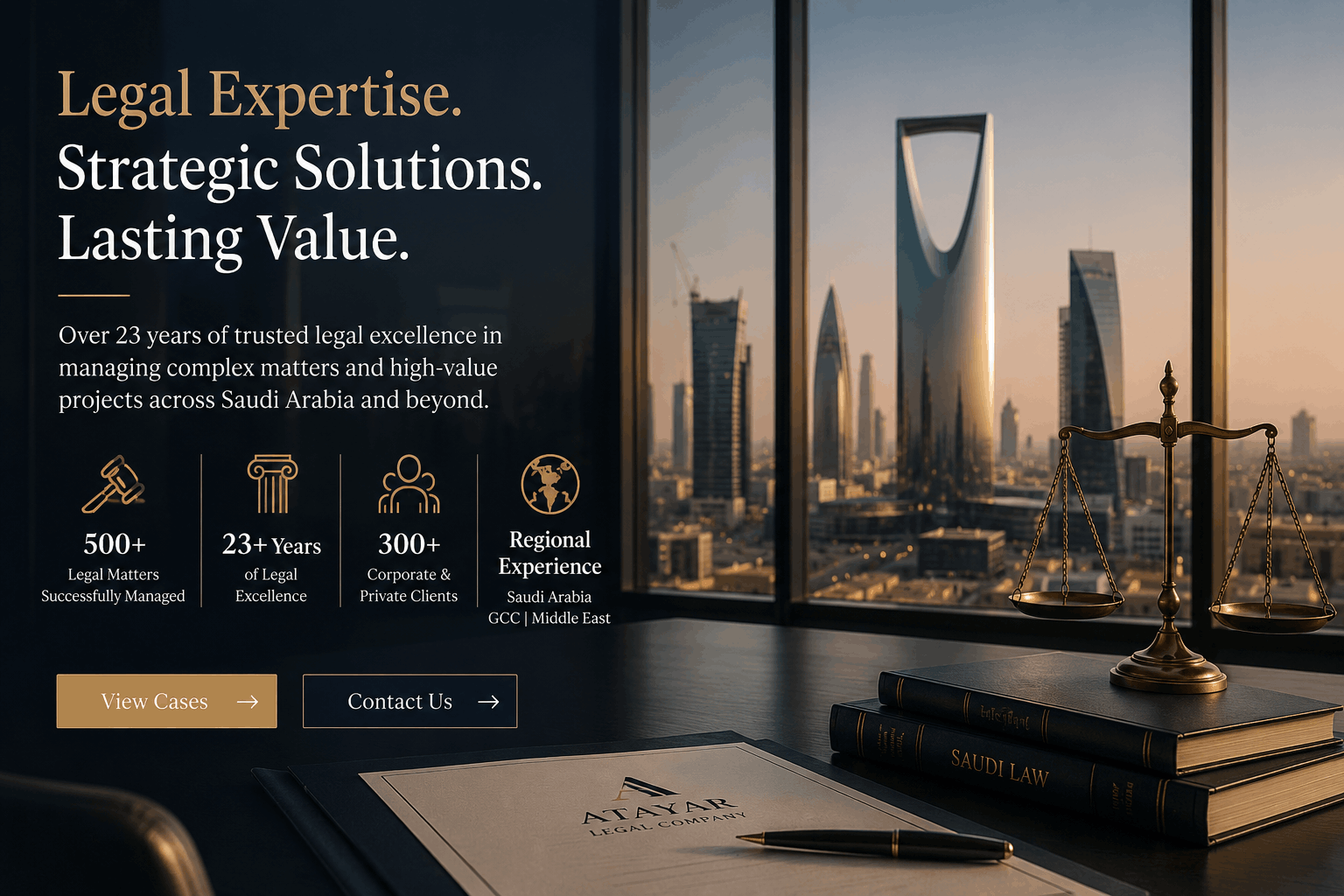
Legal Expertise in Managing High-Value Legal Matters and Strategic Projects Across Saudi Arabia and Beyond For more than 24 years, Atyar Law company has been delivering strategic legal services and trusted legal advisory to corporations, investors, government entities, financial institutions, family businesses, and private clients across the Kingdom of Saudi Arabia and internationally. Our reputation has been built on successfully managing complex legal matters, high-value disputes, and strategic projects across a broad range of industries. Supported by a team of experienced lawyers, legal consultants, former judges, and arbitration specialists, we provide practical legal solutions that combine legal excellence with commercial insight. Our legal expertise extends across corporate and commercial law, investment, construction, infrastructure, energy, arbitration, real estate, banking and finance, governance, taxation, customs, labour law, intellectual property, insurance, telecommunications, and other specialized practice areas. Beyond litigation and legal representation, we work as trusted legal partners—helping our clients identify legal risks, structure transactions, negotiate contracts, resolve disputes, and protect their investments throughout every stage of their business operations. 500+ Legal Matters Successfully Managed Representing businesses, investors, financial institutions, and government entities across multiple industries. 23+ Years Legal Excellence More than two decades of professional legal experience in Saudi Arabia and international legal matters. 300+ Corporate & Private Clients Providing strategic legal support to local and international businesses, entrepreneurs, and public sector organizations. Regional Experience Saudi Arabia • GCC • Middle East Supporting clients across the Kingdom of Saudi Arabia, the Gulf region, and cross-border legal matters. About Our Legal Expertise Throughout our professional journey, Atyar Law company has advised and represented clients operating in a wide range of commercial and investment sectors—from emerging businesses and family-owned enterprises to multinational corporations, government authorities, infrastructure developers, financial institutions, and large-scale investment projects. Our services encompass every aspect of legal practice, including legal consultation, contract drafting and review, legal opinions, commercial litigation, arbitration, dispute resolution, regulatory compliance, negotiation, and strategic legal advisory. Every matter entrusted to our team is handled with a tailored legal strategy that reflects the client’s commercial objectives while ensuring full compliance with the laws and regulations of the Kingdom of Saudi Arabia. Rather than offering standard legal advice, we provide practical legal solutions designed to protect investments, reduce legal exposure, preserve business continuity, and create long-term value for our clients. Industries We Serve Our legal experience covers a diverse portfolio of industries and sectors, enabling us to understand the unique legal and commercial challenges faced by every client. Our core areas of expertise include: Corporate & Commercial Law Investment & Foreign Investment Energy & Utilities Construction & FIDIC Contracts Real Estate & Property Development Commercial & International Arbitration Banking & Finance Customs, Import & Export Tax & Zakat Corporate Governance & Compliance Commercial & Government Contracts Labour & Employment Law Intellectual Property & Trademarks Inheritance & Estate Planning Financial Claims & Compensation Insurance Telecommunications & Technology Every legal engagement is supported by comprehensive legal analysis, strategic planning, and practical solutions tailored to the client’s industry, objectives, and regulatory environment. Why Clients Choose Atyar Law Company Selecting the right legal partner is a strategic business decision. At Atyar Law Company, we believe that exceptional legal representation goes beyond interpreting laws—it requires a deep understanding of business objectives, commercial realities, regulatory frameworks, and industry-specific challenges. For more than two decades, we have supported clients in managing legal risks, resolving complex disputes, structuring high-value transactions, and protecting their commercial interests across a wide range of industries. Our approach combines legal excellence with practical business insight, enabling our clients to make informed decisions with confidence. Clients choose Atyar Law Company because we deliver: Strategic legal advice tailored to every client and industry. Comprehensive legal risk assessment before initiating any legal action. Professional drafting and review of contracts, agreements, and legal documentation. Effective representation before Saudi courts, arbitral tribunals, and judicial committees. Practical legal solutions that support business continuity and long-term growth. The highest standards of confidentiality, integrity, and professional ethics. Every legal matter is managed with meticulous attention to detail, ensuring that our clients receive solutions that are commercially practical, legally sound, and aligned with Saudi regulations and international best Our Core Areas of Legal Expertise Our portfolio reflects extensive experience across numerous legal disciplines and major economic sectors. By combining technical legal knowledge with commercial understanding, we provide integrated legal solutions that address the evolving needs of businesses, investors, and institutions. Construction & FIDIC Contracts Construction projects involve complex contractual obligations and significant financial commitments. Our lawyers advise developers, contractors, consultants, and project owners on every stage of construction projects, including contract drafting, FIDIC agreements, variation orders, delay claims, payment disputes, performance guarantees, contract termination, and dispute resolution. Our legal strategies are designed to reduce project risks, preserve contractual rights, and support successful project delivery. Commercial & International Arbitration Alternative dispute resolution has become an essential component of modern commercial practice. Our arbitration team advises clients in domestic and international arbitration proceedings, preparing legal submissions, managing arbitration procedures, and representing clients throughout every stage of the arbitration process. We also advise on arbitration agreements, enforcement of arbitral awards, and cross-border dispute resolution in accordance with Saudi legislation and internationally recognized arbitration principles. Corporate & Investment Law Businesses require legal advisors who understand both legal requirements and commercial objectives. We assist local and international companies throughout every stage of their business lifecycle, including company formation, restructuring, mergers and acquisitions, shareholders’ agreements, corporate governance, investment protection, and commercial dispute management. Our legal solutions are designed to support sustainable business growth while ensuring regulatory compliance and protecting shareholder interests. Real Estate & Property Development The real estate sector continues to play a vital role in Saudi Arabia’s economic transformation. Our legal team advises investors, developers, property owners, and financial institutions on acquisition transactions, development agreements, leasing arrangements, ownership disputes, compensation claims, expropriation matters, and real estate investment structures. Our objective is to protect investments while facilitating successful real estate developments in accordance with Saudi laws and regulations. Banking & Finance Financial transactions require precise legal

Zakat & Tax Disputes: Legal Representation in Complex Zakat and Income Tax Matters
Atyar Law Company Zakat & Tax Disputes: Legal Representation in Complex Zakat and Income Tax Matters At Atyar Law company, we provide specialized legal services in zakat and tax disputes, including legal analysis and successful representation before the General Authority of Zakat and Income Tax in complex matters relating to zakat, income tax obligations, and regulatory compliance. These matters required advanced legal and financial expertise in Saudi zakat and tax regulations, ensuring protection of clients’ financial interests while minimizing regulatory and financial exposure associated with tax and zakat disputes. Book Appointment Contact Us +500 Legal Cases Experience In Construction Disputes +300 Clients Judgment Enforcement Execution of Court Judgments Quick Service Overview Case Type:Zakat / Tax / Financial & Regulatory Disputes Parties:Companies – Establishments – Investors – Regulatory Authorities Authority Involved:General Authority of Zakat and Income Tax Jurisdiction:Kingdom of Saudi Arabia Scope of Work:Legal Analysis – Legal Representation – Objections – Litigation Legal Services Details Atyar Law company provided comprehensive legal services in zakat and tax matters, including: Reviewing and analyzing zakat and income tax disputesRepresenting clients before the General Authority of Zakat and Income TaxPreparing legal objections and regulatory memorandaManaging disputes relating to zakat and tax liabilitiesProtecting clients’ financial and regulatory interestsProviding legal solutions supporting compliance with Saudi zakat and tax regulations These matters required precise legal and financial understanding of Saudi zakat, tax, and regulatory frameworks. Legal Challenges The matters involved several significant legal and regulatory challenges, including: Complexity of zakat and tax regulationsAnalysis of financial and regulatory obligationsProtecting clients against penalties and financial exposureManaging disputes before regulatory authoritiesEnsuring compliance with Saudi zakat and tax laws Legal Strategy The legal team at Atyar Law company adopted a comprehensive legal strategy, including: Reviewing the financial and regulatory position of clientsAnalyzing disputed zakat and tax obligationsPreparing professional objections and legal memorandaEffective representation before competent authoritiesProtecting clients’ financial rights and commercial interestsProviding legal solutions aimed at minimizing financial and regulatory risks Results Achieved ✔ Successful representation in complex zakat and tax disputes✔ Protection of clients’ financial and regulatory interests✔ Effective management of disputes before the General Authority of Zakat and Income Tax✔ Support for compliance with Saudi zakat and tax regulations✔ Reduction of financial risks and potential penalties Key Strengths of the Case Advanced expertise in Saudi zakat and tax regulationsDeep understanding of Saudi financial and regulatory frameworksStrong capability in managing complex regulatory disputesProfessional drafting of objections and legal memorandaCommitment to protecting client interests Value Delivered to Client Protection of financial rights and interestsReduction of financial penalties and regulatory exposureProfessional management of zakat and tax disputesSupport for compliance with financial regulationsComprehensive representation before competent authorities Our Services Related Legal Services Construction Disputes Specialized legal representation in all types of construction contract disputes. Commercial Litigation Comprehensive legal support in commercial cases before competent courts. Judgment Enforcement Following up on the execution of court judgments and ensuring the recovery of rights. Debt Recovery Effective legal procedures for collecting outstanding financial dues. Are you facing a zakat or tax dispute or require legal representation before the General Authority of Zakat and Income Tax? At Atyar Law company, we provide specialized legal solutions in zakat and tax disputes, helping clients protect their financial interests and maintain compliance with Saudi laws and regulations. Book Appointment Contact Us
Hajj & Umrah Sector: Drafting Share Purchase Agreements Between Partners
Atyar Law Company Hajj & Umrah Sector: Drafting Share Purchase Agreements Between Partners At Atyar Law company, we provide specialized legal services in commercial contract drafting and corporate transactions within the Hajj and Umrah sector, including the preparation and drafting of a share sale and purchase agreement between partners in a limited liability company operating in the Hajj and Umrah industry, with a transaction value exceeding SAR 4,000,000, equivalent to more than USD 1,000,000. This transaction required advanced legal expertise in corporate governance, shareholder relations, and commercial contract drafting to ensure protection of contractual rights and obligations while maintaining compliance with the commercial regulations of the Kingdom of Saudi Arabia. Book Appointment Contact Us +500 Legal Cases Experience In Construction Disputes +300 Clients Judgment Enforcement Execution of Court Judgments Quick Service Overview Service Type:Share Sale & Purchase Agreement Drafting Sector:Hajj & Umrah Company Type:Limited Liability Company (LLC) Transaction Value:More than SAR 4,000,000 Equivalent Value:More than USD 1,000,000 Jurisdiction:Kingdom of Saudi Arabia Scope of Work:Contract Drafting – Shareholder Relations – Protection of Contractual Rights Legal Services Details Atyar Law company provided comprehensive legal services in this transaction, including: Preparing and drafting the share sale and purchase agreement between the partnersStructuring contractual obligations and shareholder rightsReviewing the legal and corporate structure of the companyEnsuring compliance of the agreement with Saudi commercial regulationsProtecting the commercial and investment interests of the partnersReducing legal and regulatory risks associated with the transaction These services required precise legal and commercial understanding of Saudi regulations governing limited liability companies and businesses operating within the Hajj and Umrah sector. Legal Challenges The transaction involved several significant legal challenges, including: Structuring shareholder relationships with legal precisionProtecting contractual and financial rights of the partiesEnsuring lawful transfer of ownership interestsMaintaining compliance with commercial and regulatory requirementsMinimizing potential legal and commercial disputes Legal Strategy The legal team at Atyar Law company adopted a comprehensive legal strategy, including: Reviewing the company’s legal and financial structureAssessing contractual relationships between the partnersDrafting a professionally structured agreement protecting all parties’ interestsEnsuring compliance with Saudi commercial laws and regulationsReducing legal and regulatory exposure associated with the transactionSupporting the long-term stability and continuity of the company’s operations Results Achieved ✔ Successful drafting of a professionally structured share sale and purchase agreement✔ Protection of the commercial and financial rights of the partners✔ Ensuring compliance with Saudi commercial regulations✔ Reduction of legal and regulatory risks associated with the transaction✔ Supporting business continuity and operational stability Key Strengths of the Case Advanced expertise in corporate contracts and commercial transactionsDeep understanding of Saudi commercial regulationsStrong capability in structuring shareholder relationshipsProfessional drafting of commercial agreements and legal documentationCommitment to protecting client interests Value Delivered to Client Protection of contractual and financial rightsProfessional legal management of share transfer transactionsReduction of legal and commercial risksSupport for commercial and regulatory complianceEnhancement of business continuity and corporate stability Our Services Related Legal Services Construction Disputes Specialized legal representation in all types of construction contract disputes. Commercial Litigation Comprehensive legal support in commercial cases before competent courts. Judgment Enforcement Following up on the execution of court judgments and ensuring the recovery of rights. Debt Recovery Effective legal procedures for collecting outstanding financial dues. Do you need legal support for a share transfer transaction or shareholder agreement within a Hajj & Umrah company? At Atyar Law company, we provide specialized legal solutions in commercial contract drafting and shareholder structuring, helping clients protect their interests and ensure full compliance with Saudi laws and regulations. Book Appointment Contact Us
Hajj & Umrah Sector Disputes: Managing Partner Disputes in Hajj & Umrah Companies
Atyar Law Company Hajj & Umrah Sector Disputes: Managing Partner Disputes in Hajj & Umrah Companies At Atyar Law company, we provide specialized legal services in corporate and shareholder disputes within the Hajj and Umrah sector, including drafting legal memoranda and successful litigation representation for a Saudi partner against another partner in a limited liability company operating in the Hajj and Umrah industry. This matter required advanced legal expertise in Saudi commercial regulations, corporate governance, and shareholder dispute resolution, ensuring protection of the client’s commercial and regulatory rights in accordance with the laws and regulations of the Kingdom of Saudi Arabia. Book Appointment Contact Us +500 Legal Cases Experience In Construction Disputes +300 Clients Judgment Enforcement Execution of Court Judgments Case Overview Case Type:Shareholder Dispute / Limited Liability Company Dispute Sector:Saudi Hajj & Umrah Parties:Saudi Partner vs. Business Partner Jurisdiction:Kingdom of Saudi Arabia Scope of Work:Legal Memoranda – Litigation – Protection of Shareholder Rights Case Details Atyar Law company provided comprehensive legal services in this matter, including: Preparing legal memoranda and judicial submissionsRepresenting the client before competent judicial authoritiesProtecting the shareholder’s commercial and regulatory rightsManaging disputes between partners within the company structureSupporting the client in resolving the dispute under Saudi commercial lawsProviding legal solutions aimed at protecting business continuity and operational stability This matter required precise legal understanding of Saudi corporate regulations governing limited liability companies and the operational framework of the Hajj and Umrah sector. Legal Challenges The matter involved several significant legal challenges, including: Complexity of shareholder relationships and corporate obligationsProtecting commercial and regulatory rights within the companyManaging disputes while preserving business continuityAddressing regulatory obligations associated with the Hajj and Umrah sectorReducing potential commercial and operational risks Legal Strategy The legal team at Atyar Law company adopted a comprehensive legal strategy, including: Reviewing agreements and contractual arrangements between the partnersPreparing professional legal memoranda supported by evidenceEffective representation before competent judicial authoritiesProtecting the client’s commercial and regulatory rightsProviding legal solutions supporting corporate stability and continuityReducing commercial and regulatory risks associated with the dispute Results Achieved ✔ Successful legal representation in a shareholder dispute within the Hajj & Umrah sector✔ Protection of the client’s commercial and regulatory rights✔ Effective management of disputes between business partners✔ Support for business continuity and operational stability✔ Reduction of risks and losses associated with corporate disputes Key Strengths of the Case Advanced expertise in corporate and shareholder disputesDeep understanding of Saudi commercial regulationsStrong capability in managing sensitive commercial disputesProfessional drafting of legal memoranda and pleadingsCommitment to protecting client interests Value Delivered to Client Protection of commercial and regulatory rightsProfessional management of shareholder disputesReduction of commercial and operational risksComprehensive representation before judicial authoritiesStrategic legal support for business continuity Our Services Related Legal Services Construction Disputes Specialized legal representation in all types of construction contract disputes. Commercial Litigation Comprehensive legal support in commercial cases before competent courts. Judgment Enforcement Following up on the execution of court judgments and ensuring the recovery of rights. Debt Recovery Effective legal procedures for collecting outstanding financial dues. Are you facing a shareholder or corporate dispute within the Hajj & Umrah sector? At Atyar Law company, we provide specialized legal solutions in shareholder disputes and corporate litigation, helping clients protect their commercial rights and achieve effective legal outcomes under Saudi laws and regulations. Book Appointment Contact Us
Construction & Building Disputes: Managing Financial Claims for Contracting Companies
Atyar Law Company Construction & Building Disputes: Managing Financial Claims for Contracting Companies At Atyar Law company, we provide specialized legal services in construction and infrastructure disputes, including legal advisory, drafting legal memoranda, and successful litigation representation for more than three Saudi contracting companies in disputes involving financial claims and contractual matters exceeding SAR 2,000,000, equivalent to more than USD 500,000. These matters required advanced legal expertise in construction contracts, financial claims, and disputes arising from construction and infrastructure projects, ensuring protection of clients’ contractual and financial rights. Book Appointment Contact Us +500 Legal Cases Experience In Construction Disputes +300 Clients Judgment Enforcement Execution of Court Judgments Case Overview Case Type:Construction Disputes / Financial Claims / Contractual Disputes Parties:Saudi Contracting Companies Claim Value:More than SAR 2,000,000 Equivalent Value:More than USD 500,000 Sector:Construction & Infrastructure Jurisdiction:Kingdom of Saudi Arabia Scope of Work:Legal Advisory – Legal Memoranda – Litigation – Protection of Contractual & Financial Rights Case Details Atyar Law company provided comprehensive legal services in this matter, including: Advising on construction contracts and government project disputes Preparing legal memoranda and judicial submissions Representing clients before competent judicial authorities Pursuing unpaid project certificates and financial entitlements Claiming compensation for project-related damages and losses Protecting the contractual and financial rights of contracting companies This matter required advanced legal expertise in Saudi commercial and administrative laws, construction contracts, and financial claims relating to government projects Legal Challenges The matters involved several significant legal challenges, including: Complexity of construction contracts and infrastructure projects Establishing contractual entitlements and financial rights Protecting the commercial interests of contracting companies Managing disputes arising during project execution Minimizing financial losses and legal exposure Legal Strategy The legal team at Atyar Law company adopted a comprehensive legal strategy, including: Reviewing and analyzing construction contracts and supporting project documentation Preparing professional legal memoranda supported by evidence Effective representation before competent judicial authorities Protecting clients’ financial and commercial rights Supporting claims relating to payments and compensation Reducing risks and losses associated with contractual disputes Results Achieved ✔ Successful representation of more than three Saudi contracting companies✔ Protection of clients’ contractual and financial rights✔ Effective management of disputes relating to project payments and entitlements✔ Achieving legal outcomes supporting contracting companies’ commercial interests✔ Reduction of risks and losses associated with contractual disputes Key Strengths of the Case Advanced expertise in construction and contracting disputes Deep understanding of Saudi construction and commercial regulations Strong capability in managing contractual and commercial disputes Professional drafting of legal memoranda and pleadings Commitment to protecting client interests Value Delivered to Client Protection of contractual and financial rights Professional management of construction disputes Reduction of financial and legal exposure Comprehensive representation before judicial authorities Strategic legal support for construction and infrastructure projects Our Services Related Legal Services Construction Disputes Specialized legal representation in all types of construction contract disputes. Commercial Litigation Comprehensive legal support in commercial cases before competent courts. Judgment Enforcement Following up on the execution of court judgments and ensuring the recovery of rights. Debt Recovery Effective legal procedures for collecting outstanding financial dues. Are you facing a construction dispute or financial claim relating to a building or infrastructure project? At Atyar Law company, we provide specialized legal solutions in construction and infrastructure disputes, helping clients protect their contractual and financial rights and achieve effective legal outcomes under Saudi laws and regulations. Book Appointment Contact Us
Construction & Infrastructure Disputes: Financial Claims and Compensation Exceeding SAR 50 Million
Atyar Law Company Construction & Infrastructure Disputes: Financial Claims and Compensation Exceeding SAR 50 Million At Atyar Law company, we provide specialized legal services in construction, infrastructure, and contracting disputes, including legal advisory, drafting legal memoranda, and litigation representation for foreign and Saudi contracting companies in high-value disputes relating to project payments, financial entitlements, and compensation claims. In one significant matter, Atyar Law company represented a foreign contracting company and a Saudi contracting company in litigation against a Saudi ministry involving claims exceeding SAR 50,000,000, equivalent to more than USD 13,000,000. The dispute related to unpaid project certificates, financial entitlements, and compensation claims arising from damages and losses connected to a construction project, requiring advanced legal expertise in construction contracts, government project disputes, and financial claims. Book Appointment Contact Us +500 Legal Cases Experience In Construction Disputes +300 Clients Judgment Enforcement Execution of Court Judgments Case Overview Case Type:Construction Dispute / Financial Entitlements / Compensation Claims Parties:Foreign Contracting Company – Saudi Contracting Company – Saudi Ministry Claim Value:More than SAR 50,000,000 Equivalent Value:More than USD 13,000,000 Sector:Construction & Infrastructure Jurisdiction:Kingdom of Saudi Arabia Scope of Work:Legal Advisory – Legal Memoranda – Litigation – Financial & Compensation Claims Case Details Atyar Law company provided comprehensive legal services in this matter, including: Advising on construction contracts and government project disputes Preparing legal memoranda and judicial submissions Representing clients before competent judicial authorities Pursuing unpaid project certificates and financial entitlements Claiming compensation for project-related damages and losses Protecting the contractual and financial rights of contracting companies This matter required advanced legal expertise in Saudi commercial and administrative laws, construction contracts, and financial claims relating to government projects Legal Challenges The matter involved several significant legal challenges, including: High-value financial claims Complexity of government contracts and construction projects Establishing damages and financial losses Protecting contractual rights of contracting companies Managing disputes involving multiple parties and authorities Legal Strategy The legal team at Atyar Law company adopted a comprehensive legal strategy, including: Reviewing and analyzing construction contracts and supporting technical and financial documentation Preparing professional legal memoranda supported by evidence Effective representation before competent judicial authorities Protecting clients’ financial and contractual rights Supporting claims relating to project certificates and compensation Minimizing legal and financial exposure associated with project disputes Results Achieved ✔ Successful legal representation for foreign and Saudi contracting companies✔ Protection of clients’ contractual and financial rights✔ Effective management of claims relating to project certificates and compensation✔ Delivery of legal solutions supporting clients’ commercial interests✔ Reduction of risks and losses associated with contractual and government disputes Key Strengths of the Case Advanced expertise in construction and government project disputes Deep understanding of Saudi construction laws and contracting regulations Strong capability in managing complex high-value disputes Professional drafting of legal memoranda and pleadings Value Delivered to Client Protection of financial and contractual rights Professional management of construction disputes Reduction of financial and legal exposure Comprehensive representation before judicial authorities Our Services Related Legal Services Construction Disputes Specialized legal representation in all types of construction contract disputes. Commercial Litigation Comprehensive legal support in commercial cases before competent courts. Judgment Enforcement Following up on the execution of court judgments and ensuring the recovery of rights. Debt Recovery Effective legal procedures for collecting outstanding financial dues. Are you facing a construction dispute involving unpaid project certificates, compensation claims, or government contracts? At Atyar Law company, we provide specialized legal solutions in construction and infrastructure disputes, helping clients protect their contractual and financial rights and achieve effective legal outcomes under Saudi laws and regulations. Book Appointment Contact Us
“Commercial Fraud, Standards & Metrology: Combating Counterfeiting and Protection of Trademarks and Products”
Atyar Law Company “Commercial Fraud, Standards & Metrology: Combating Counterfeiting and Protection of Trademarks and Products” At Atyar Law company, we provide specialized legal services in commercial fraud, counterfeit products, trademark infringement, and standards and metrology violations, including legal advisory relating to anti-commercial fraud measures, protection of trademarks and products against imitation and counterfeiting, and enforcement actions against violations of approved standards and specifications. In addition, Atyar Law company prepared legal memoranda and represented clients before competent authorities, including the Saudi Food and Drug Authority (SFDA), the General Department for Combating Commercial Fraud at the Ministry of Commerce and Book Appointment Contact Us +500 Legal Cases Experience In Construction Disputes +300 Clients Judgment Enforcement Execution of Court Judgments Quick Service Overview Case Type:Commercial Fraud / Trademark Counterfeiting / Standards & Specification Violations Parties: Companies – Manufacturers – Distributors – Regulatory Authorities Authorities Involved:: Ministry of Commerce and Investment – Saudi Food and Drug Authority – Public Prosecution – Oversight & Anti-Corruption Authority Jurisdiction:Kingdom of Saudi Arabia Scope of WorkLegal Advisory – Legal Memoranda – Litigation – Trademark & Product Protection Case Details Atyar Law company provided comprehensive legal services in customs and import/export disputes, including: Advising on commercial transactions and import/export matters Preparing legal memoranda and judicial submissions Representing clients before competent courts in commercial and financial disputes Protecting financial rights arising from contracts and commercial papers Representing partners against contractors in financial claims exceeding SAR 15,000,000 Representing a Saudi partner against an energy-sector company in a dispute exceeding SAR 30,000,000 These matters required advanced legal expertise in Saudi commercial, regulatory, and enforcement frameworks governing customs procedures, import/export activities, and negotiable instruments. Legal Challenges The matters involved several significant legal challenges, including: Complexity of commercial fraud and counterfeiting disputes Protecting trademarks and commercial rights against infringement Coordinating with multiple regulatory and enforcement authorities Establishing violations relating to standards and specifications Managing multi-party commercial and regulatory disputes Legal Strategy The legal team at Atyar Law company adopted a comprehensive legal strategy, including: Reviewing and analyzing disputed products and regulatory violations Preparing professional legal memoranda supported by evidence Effective representation before judicial and regulatory authorities Coordinating enforcement actions involving seizure, confiscation, and destruction procedures Protecting clients’ trademarks and commercial rights Supporting compliance with standards, specifications, and regulatory frameworks Results Achieved ✔ Successful seizure and destruction of counterfeit and adulterated products✔ Protection of trademarks and products against imitation and infringement✔ Effective legal representation before regulatory and enforcement authorities✔ Support for compliance with approved standards and specifications✔ Reduction of commercial and regulatory risks associated with fraud and counterfeiting Key Strengths of the Case Advanced expertise in commercial fraud and anti-counterfeiting matters Deep understanding of Saudi commercial and regulatory laws Strong capability in managing complex regulatory disputes Professional drafting of legal memoranda and defenses Commitment to protecting client interests and commercial rights Value Delivered to Client Protection of trademarks and commercial products Reduction of commercial and regulatory exposure Professional management of commercial fraud disputes Support for compliance with standards and regulatory requirements Comprehensive representation before competent authorities Our Services Related Legal Services Construction Disputes Specialized legal representation in all types of construction contract disputes. Commercial Litigation Comprehensive legal support in commercial cases before competent courts. Judgment Enforcement Following up on the execution of court judgments and ensuring the recovery of rights. Debt Recovery Effective legal procedures for collecting outstanding financial dues. Are you facing commercial fraud, counterfeit products, or regulatory violations relating to standards and specifications? At Atyar Law company, we provide specialized legal solutions in commercial fraud, anti-counterfeiting enforcement, and trademark protection, helping businesses protect their products, brands, and commercial interests under Saudi laws and regulations. Book Appointment Contact Us
Customs, Import & Export Disputes: Managing High-Value Commercial & Financial Claims
Atyar Law Company Customs, Import & Export Disputes: Managing High-Value Commercial & Financial Claims At Atyar Law company, we provide specialized legal services in customs, import and export disputes, and commercial papers litigation, including legal advisory, drafting legal memoranda, and successful litigation representation in more than 113 cases involving cheques, promissory notes, bills of exchange, and complex commercial and financial claims, with total claims exceeding SAR 176,000,000, equivalent to more than USD 47,000,000. These matters included representing business partners, contractors, and companies operating across commercial and industrial sectors, including the energy sector, in disputes relating to contractual obligations, commercial papers, customs-related transactions, and import/export activities. Book Appointment Contact Us +500 Legal Cases Experience In Construction Disputes +300 Clients Judgment Enforcement Execution of Court Judgments Case Overview Case Type:Customs / Import & Export / Commercial Papers / Financial Claims Number of Cases:More than 113 Cases Claim Value:More than SAR 176,000,000 Equivalent Value:More than USD 47,000,000 Parties:Business Partners – Contractors – Commercial & Industrial Companies – Energy Sector Companies Jurisdiction:Kingdom of Saudi Arabia Scope of Work:Legal Advisory – Legal Memoranda – Litigation – Protection of Commercial & Financial Rights Case Details Atyar Law company provided comprehensive legal services in customs and import/export disputes, including: Advising on commercial transactions and import/export matters Preparing legal memoranda and judicial submissions Representing clients before competent courts in commercial and financial disputes Protecting financial rights arising from contracts and commercial papers Representing partners against contractors in financial claims exceeding SAR 15,000,000 Representing a Saudi partner against an energy-sector company in a dispute exceeding SAR 30,000,000 These matters required advanced legal expertise in Saudi commercial, regulatory, and enforcement frameworks governing customs procedures, import/export activities, and negotiable instruments. Legal Challenges The matters involved several significant legal challenges, including: High-value financial claims Complexity of commercial and contractual relationships Establishing financial obligations arising from contracts and commercial papers Protecting clients’ commercial and investment interests Managing disputes involving multiple parties and business sectors Legal Strategy The legal team at Atyar Law company adopted a comprehensive legal strategy, including: Reviewing and analyzing contracts, commercial papers, and related transactions Preparing professional legal memoranda supported by evidence Effective representation before competent judicial and regulatory authorities Protecting clients’ financial and commercial rights Managing commercial disputes with strategic legal precision Reducing financial and legal exposure associated with commercial disputes Results Achieved Successful representation in more than 113 commercial and financial disputes✔ Protection of clients’ financial and commercial rights✔ Effective management of disputes involving contracts and commercial papers✔ Achieving legal outcomes supporting clients’ commercial and investment interests✔ Reduction of financial risks and losses associated with commercial disputes Key Strengths of the Case Advanced expertise in commercial and regulatory disputes Deep understanding of Saudi commercial and enforcement laws Strong capability in managing complex high-value disputes Professional drafting of legal memoranda and pleadings Value Delivered to Client Protection of financial and commercial rights Professional management of commercial disputes Reduction of financial and legal exposure Comprehensive representation before judicial authorities Strategic legal support in customs, import, and export matters Our Services Related Legal Services Construction Disputes Specialized legal representation in all types of construction contract disputes. Commercial Litigation Comprehensive legal support in commercial cases before competent courts. Judgment Enforcement Following up on the execution of court judgments and ensuring the recovery of rights. Debt Recovery Effective legal procedures for collecting outstanding financial dues. Are you facing a dispute relating to customs procedures, import/export transactions, or commercial financial claims? At Atyar Law company, we provide specialized legal solutions in customs, import and export disputes, and commercial litigation, helping clients protect their commercial and financial rights with efficiency and professional excellence. Book Appointment Contact Us
Competition & Anti-Monopoly Disputes: Defense Against Unfair Competition Claims
Atyar Law Company Competition & Anti-Monopoly Disputes: Defense Against Unfair Competition Claims At Atyar Law company, we provide specialized legal services in competition law, anti-monopoly disputes, and unfair competition matters, including legal advisory, drafting legal memoranda, and defending clients in claims relating to anti-competitive conduct and unlawful market practices before the Ministry of Commerce and Investment and competent regulatory authorities in the Kingdom of Saudi Arabia. These matters require advanced legal expertise in Saudi commercial and regulatory frameworks governing fair competition and anti-monopoly compliance, ensuring protection of clients’ commercial interests while minimizing regulatory and legal exposure. Book Appointment Contact Us +500 Legal Cases Experience In Construction Disputes +300 Clients Judgment Enforcement Execution of Court Judgments Quick Service Overview Case Type:Anti-Monopoly / Unfair Competition / Commercial & Regulatory Violations Parties: :Companies – Investors – Regulatory Authorities – Commercial Entities Authorities Involved: Ministry of Commerce and Investment – Competent Regulatory Authorities Jurisdiction: Kingdom of Saudi Arabia Scope of Work: Legal Advisory – Legal Memoranda – Legal Defense – Commercial Compliance Case Details Atyar Law company provided comprehensive legal services in cheque and commercial paper disputes, including: Advising clients on cheque-related liabilities and commercial obligations Preparing legal memoranda and criminal defense submissions Representing clients before criminal courts and appellate courts Defending clients in bounced cheque criminal proceedings Challenging allegations and criminal procedures relating to commercial papers Protecting clients’ legal and commercial rights These matters required advanced legal expertise in Saudi criminal, commercial, and enforcement regulations governing cheques and negotiable instruments. Legal Challenges Complexity of commercial and regulatory frameworks Assessing legality of commercial practices and market conduct Protecting clients against regulatory penalties and violations Managing disputes involving unfair competition allegations Ensuring compliance with Saudi competition and anti-monopoly laws Legal Strategy The legal team at Atyar Law company adopted a comprehensive legal strategy, including: Reviewing disputed commercial activities and business practices Analyzing the legal and regulatory aspects of the claims Preparing professional legal memoranda supported by evidence Representing clients before competent regulatory authorities Providing legal solutions supporting regulatory compliance Results Achieved ✔ Effective legal defense in unfair competition and anti-monopoly disputes✔ Protection of clients’ commercial and regulatory interests✔ Support for compliance with Saudi commercial regulations✔ Reduction of regulatory risks and potential penalties✔ Professional management of commercial and regulatory disputes Key Strengths of the Case Advanced expertise in commercial and regulatory laws Deep understanding of Saudi competition and anti-monopoly regulations Strong capability in managing complex regulatory disputes Professional drafting of legal memoranda and defenses Commitment to protecting client business interests Value Delivered to Client Protection of businesses from regulatory exposure Support for lawful commercial competition and compliance Reduction of risks associated with penalties and violations Professional management of regulatory and commercial disputes Strategic legal support for business continuity and market stability Our Services Related Legal Services Construction Disputes Specialized legal representation in all types of construction contract disputes. Commercial Litigation Comprehensive legal support in commercial cases before competent courts. Judgment Enforcement Following up on the execution of court judgments and ensuring the recovery of rights. Debt Recovery Effective legal procedures for collecting outstanding financial dues. Are you facing an unfair competition claim or anti-monopoly investigation? At Atyar Law company, we provide specialized legal solutions in competition and anti-monopoly disputes, helping businesses protect their commercial interests and reduce legal and regulatory risks in accordance with Saudi laws and regulations. Book Appointment Contact Us
